

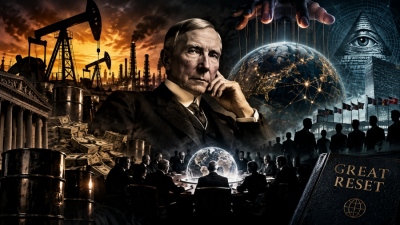
Few family names have acquired such heavy historical and symbolic weight as Rockefeller. For more than a century, this particular family has been linked to oil, banking, major corporate interests, and, at the same time, to some of the most persistent conspiracy theories surrounding the so-called "New World Order." At the center of this story stands John D. Rockefeller, the man who came to be considered the first billionaire in history and who, through Standard Oil, acquired almost unimaginable power in the US oil market. The material under examination highlights that the Rockefellers, along with the Rothschilds, later became subjects of dark theories alleging they collaborated with secret elites to construct a "New World Order" and even control the world. The true history, however, is striking in its own right and needs no myths to inspire awe.
From poverty and "Devil Bill" to the first business foundation
John D. Rockefeller grew up in a family of sharp contrasts. His father, known by the nickname "Devil Bill," presented himself as a businessman, but in practice traveled around selling herbs and elixirs during an era when such activities were frequently associated with fraud. By contrast, his mother was deeply religious, frugal, and strict in financial management. This environment appears to have profoundly influenced the young Rockefeller. From an early age, he learned to save, keep account ledgers, lend money, and approach financial activity with near-obsessive discipline. He trained as a bookkeeper and later entered the food and supply business using his savings along with borrowed capital from his father. The major turning point came with oil.
The oil boom that changed everything
During the American Civil War, demand for kerosene surged dramatically and oil prices skyrocketed. At that time, many entrepreneurs rushed into the market seeking quick profits. Rockefeller, however, took a different approach. Instead of viewing byproducts as useless waste, he transformed them into new marketable goods. Gasoline was used as fuel within the refinery itself, while heavy residues were processed into lubricants, paraffin, and other items. Simultaneously, he drastically reduced operational costs by employing his own engineers and manufacturing his own barrels. This obsession with efficiency was destined to become the bedrock of his empire.
Standard Oil and the conquest of the market
The founding and expansion of Standard Oil reshaped the US oil industry. Rockefeller deployed his profits to buy out competitors and expand into related sectors, such as rail transportation. In 1872, according to the text, Standard Oil acquired 22 out of 26 oil companies in Cleveland. In many cases, the company's market power was such that rivals considered selling out preferable to an exhausting battle for survival. This strategy yielded spectacular results. By the late 1870s, Standard Oil was refining approximately 90% of American crude oil. At the same time, the company had managed to drive down kerosene prices, turning it from a luxury item into a mass consumer good. Success, however, had another side.
When success turned into fear of monopoly
By the early 20th century, Standard Oil's power had grown so immense that the US federal government began viewing it as a threat to competition. With Theodore Roosevelt's rise to the presidency, a more aggressive policy against monopolies was initiated. Standard Oil faced consecutive court cases, federal investigations, and fierce journalistic scrutiny. Public discourse saw widespread allegations of corporate espionage, price wars, pressure on competitors, and attempts to circumvent legal procedures. The atmosphere turned so negative that Rockefeller's public image, as noted in the original text, began acquiring almost "hellish" characteristics. In 1911 came the decisive blow. The US Supreme Court ruled that Standard Oil violated antitrust laws and ordered its dissolution. From its broken-up pieces emerged entities that later evolved into household names like Conoco, Amoco, Chevron, and ExxonMobil. The business empire was shattered, but the family's wealth did not vanish.
The first billionaire and the birth of the myth
By 1916, John D. Rockefeller was already being featured by the press as the first billionaire in history. The figure was an estimate rather than a precise accounting calculation, yet it captured the colossal magnitude of his wealth. At the same time, he directed vast sums toward philanthropic causes, exceeding $500 million according to the text. Despite his fortune, he did not hold a reputation for indulging in extreme luxury or ostentatious consumption. Nevertheless, the family's actual economic power was already sufficient to fuel an entire mythology.
David Rockefeller and the era of international elites
The next major figure of the dynasty was David Rockefeller, John's grandson, who stepped away from the purely oil-focused world and turned to the financial sector, serving for years in a leadership role at Chase Manhattan. David Rockefeller also founded the Trilateral Commission, an organization aimed at bringing political and economic elites from North America, Western Europe, and Asia closer together. The material also mentions close ties with the Bilderberg Group and the Council on Foreign Relations, organizations linked in the public imagination with globalization and closed decision-making circles. From that point forward, the ground was fertile for conspiracy theories.
The "New World Order" and accusations of global control
During the 20th century, particularly within American far-right circles, a belief spread that the Rockefellers and other powerful families sought to establish a global government. Larry McDonald, an American politician, asserted in 1975 that the Rockefellers and their allies had for decades used their financial power with the objective of first controlling the US politically and subsequently the rest of the world. The text itself presents this view as a theory that gained significant traction primarily among far-right and anti-government circles. Within this narrative, international banks, political elites, and secretive organizations were portrayed as pieces of a blueprint to form a "New World Order." However, actual economic and political influence is one thing, and proving a unified, secretive global conspiracy is quite another. The former is extensively documented through the history of the Rockefellers. The latter remains a theory.
And today? Who truly rules the world?
Perhaps the most interesting point of the original text appears at the end. If the Rockefeller family still held the near-absolute control attributed to it by conspiracy theories, one would expect its members to remain at the top of global wealth rankings. Yet reality looks quite different. Today's list of the most powerful business figures is dominated by individuals like Elon Musk, Jeff Bezos, Larry Page, and Michael Dell—products of the tech industry and digital era rather than the old oil aristocracy.
This does not mean the Rockefeller family ceased to be historically significant or lost all influence. It does mean, however, that the landscape of economic power has shifted. Power moved from oil and railway lines to banking, and from there to technology, big data, and the digital economy. And perhaps that is the real story behind the myth of the "New World Order": not a single family ruling the world eternally, but a continuous shift of authority from one economic elite to the next. The Rockefellers, nonetheless, achieved something very few dynasties ever managed. More than a century after the rise of John D. Rockefeller, their name continues to evoke the same blend of admiration, fear, and suspicion. And that, in itself, is perhaps the greatest proof of the magnitude of the myth they left behind... or perhaps continues... beneath the surface.
www.bankingnews.gr






Σχόλια αναγνωστών